
Beyond DSM Limitations: A New Assessment Paradigm
The Diagnostic and Statistical Manual has dominated mental health assessment since the 1980s, providing essential clinical standardization and reimbursement frameworks. However, decades of psychopathology research have revealed significant limitations in the categorical DSM approach, including high comorbidity rates, within-disorder heterogeneity, and arbitrary diagnostic thresholds. The emergence of dimensional and multivariate methodologies in the 1990s demonstrated that psychopathology exists on a continuum from normal to abnormal functioning, with latent structures potentially offering more parsimonious organization for classification, genetic research, neurobiological processes, and treatment development.
Transdiagnostic Models: Evidence-Based Foundation
Contemporary research has consistently identified three core transdiagnostic dimensions underlying mental health conditions: Internalizing, Externalizing, and Thought-Impairing (Reality-Impairing). Krueger's seminal 1999 research demonstrated that ten common mental disorders could be reorganized into these broader dimensional categories, findings that have been replicated across diverse samples, measures, and research methodologies. These models start with traditional DSM disorders but reorganize them into an integrated multi-level structure that better captures the complexity of mental health presentations.
The MaiNDS: Bridging Research and Clinical Practice
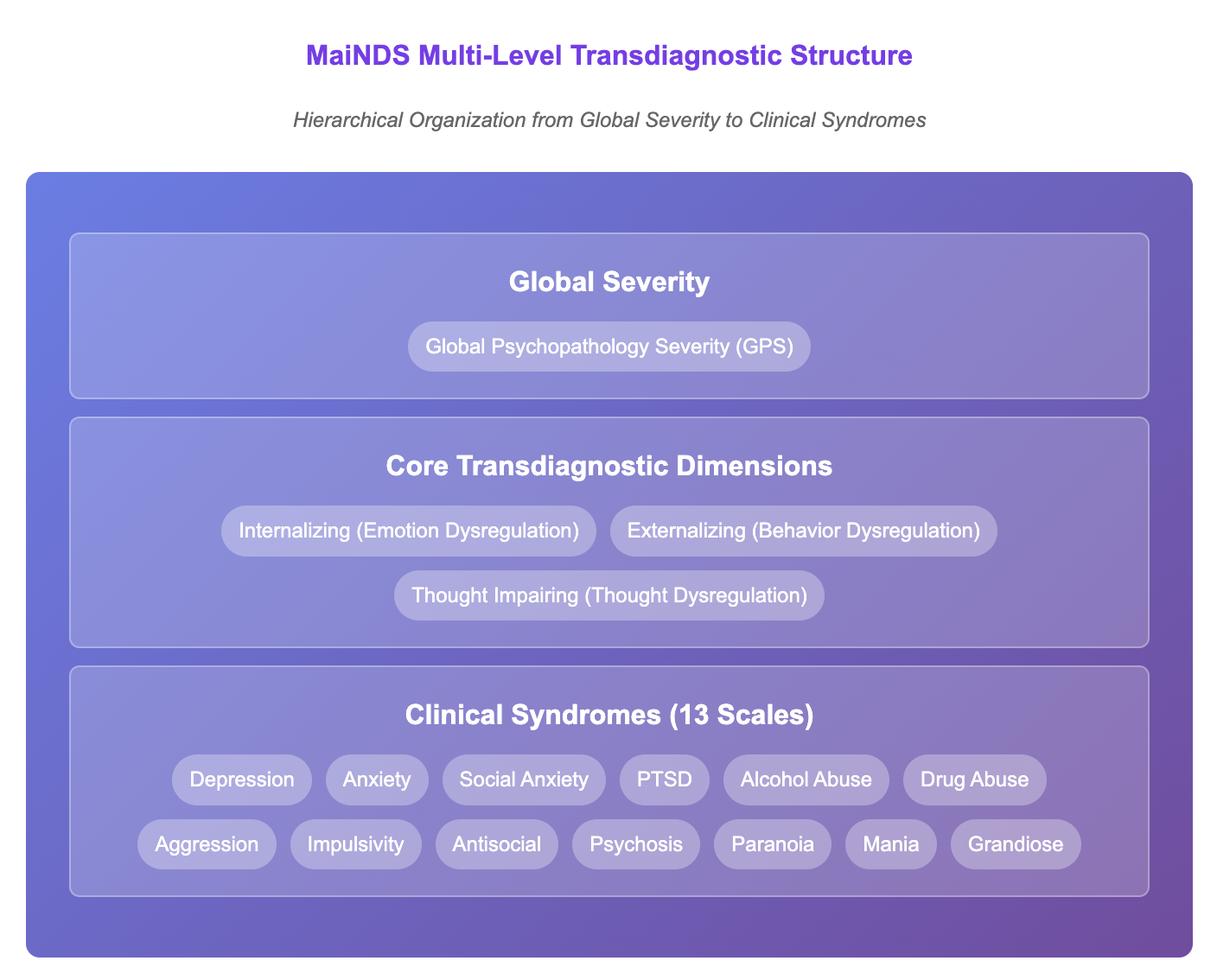
The Multi-Level Transdiagnostic Assessment Inventory (MaiNDS) addresses the critical need for contemporary assessment tools that align with modern psychopathology research while maintaining DSM compatibility. This comprehensive instrument includes Global Psychopathology Severity scoring, three transdiagnostic scales (Emotion Dysregulation, Behavior Dysregulation, and Thought Dysregulation), thirteen clinical scales balanced across core dimensions, seven supplemental scales for enhanced clinical utility, and validity measures.
Robust Psychometric Development and Validation
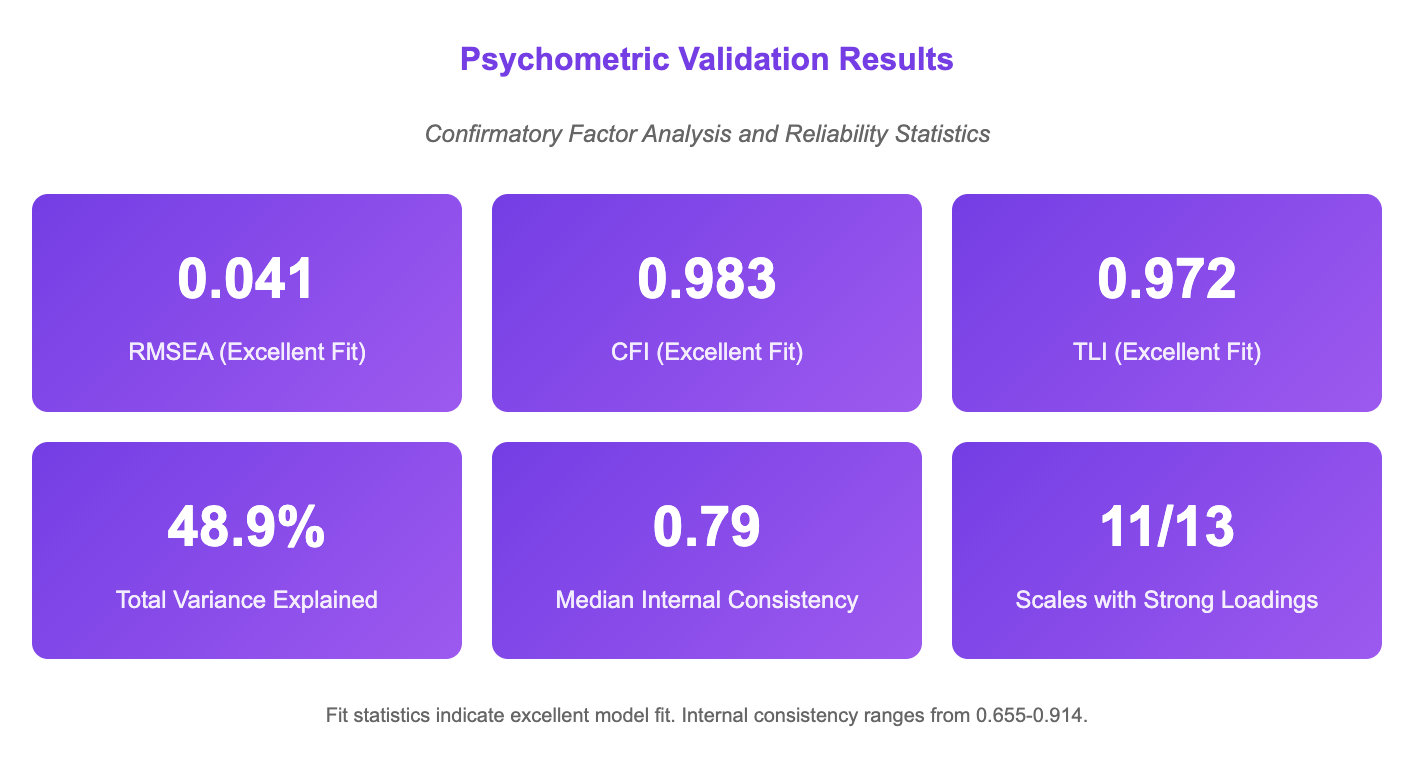
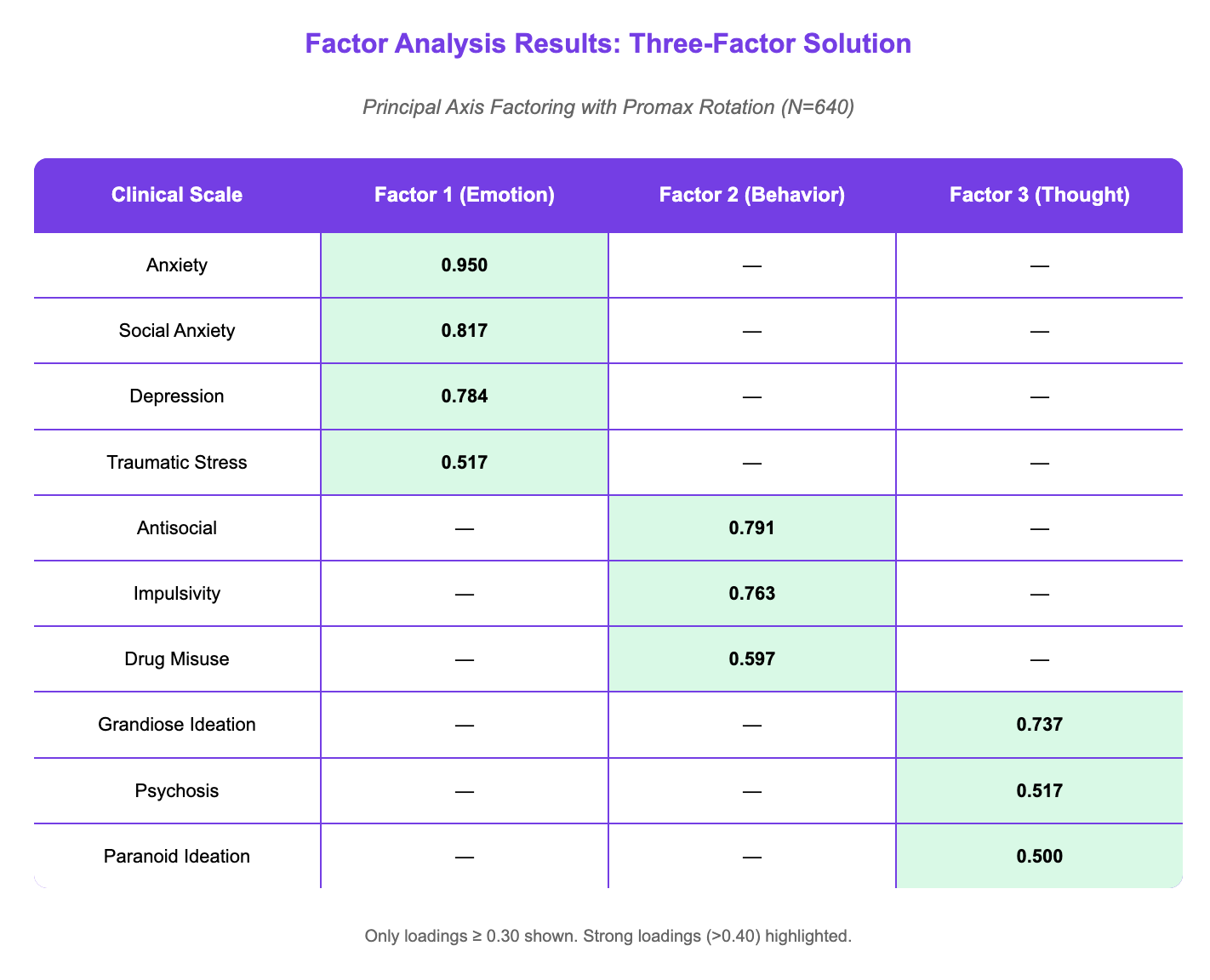
The MaiNDS underwent rigorous multi-phase development involving 830 subjects recruited through the Prolific platform, with 640 forming the normative sample representing diverse demographics. Factor analysis confirmed the three-factor structure with excellent fit statistics (RMSEA = 0.041, CFI = 0.983, TLI = 0.972), accounting for 48.90% of total variance. Internal consistency ranged from 0.655 to 0.914 with median reliability of 0.79. Scale loadings were generally strong (>0.40 for 11 of 13 scales) and specific to their intended factors.
Clinical Validity and Differentiation
Concurrent validity assessment using the DSM-5 Level 1 Cross-Cutting Symptom Measure demonstrated strong correlations, with most MaiNDS scales achieving correlations >0.50 with their DSM targets. Clinical utility analysis revealed significant differentiation between treatment and non-treatment groups across 12 clinical scales and all transdiagnostic measures. Effect sizes ranged from large (>0.80 for Depression, Anxiety, and Traumatic Stress) to moderate (>0.50 for Social Anxiety, Anger, Impulsivity, and Manic Activation), supporting robust clinical discrimination capabilities.
Next-Generation Assessment Integration
The MaiNDS represents a paradigm shift toward evidence-based transdiagnostic assessment while maintaining clinical continuity with DSM frameworks. Its alignment with contemporary psychopathology models enables integration of emerging research discoveries into clinical practice. MedLink Global has enhanced the assessment through AI integration, featuring an AI agent trained to review and explore MaiNDS profiles with patients, providing personalized interpretations and contextualized mental health insights.
Clinical Implementation and Future Directions
The MaiNDS eliminates arbitrary diagnostic thresholds while providing comprehensive assessment across multiple hierarchical levels. This approach streamlines diagnostic processes by focusing on core psychopathology dimensions rather than categorical distinctions. The instrument's transdiagnostic structure offers more coherent case conceptualization for complex presentations, potentially improving treatment selection and outcome monitoring. Early adoption should focus on settings where comprehensive psychological assessment is prioritized and where clinicians value empirically-supported approaches to mental health evaluation.